wheel TESLA MODEL S 2017 (UK) Owner's Guide
[x] Cancel search | Manufacturer: TESLA, Model Year: 2017, Model line: MODEL S, Model: TESLA MODEL S 2017Pages: 186, PDF Size: 4.67 MB
Page 141 of 186
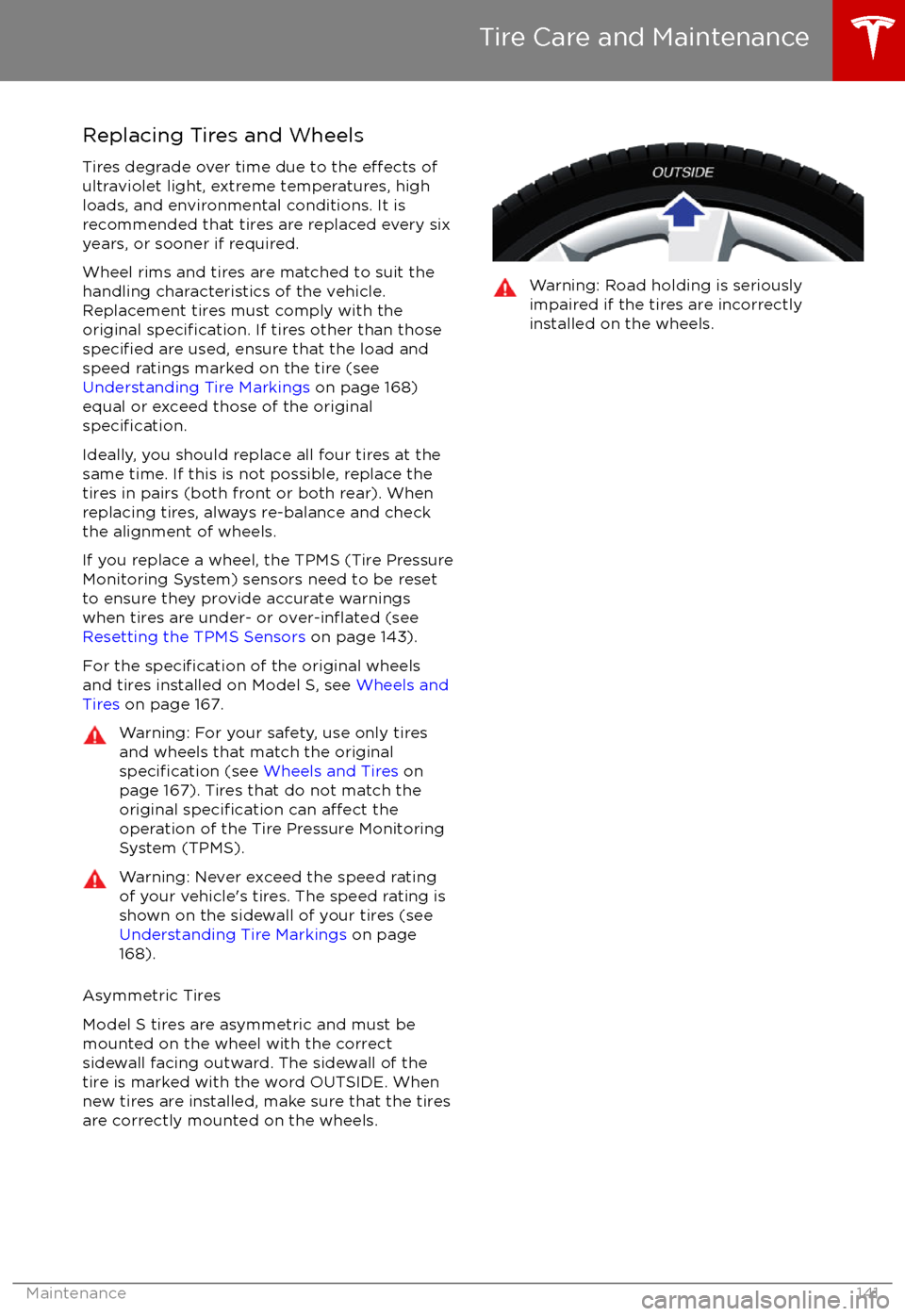
Replacing Tires and Wheels
Tires degrade over time due to the
effects of
ultraviolet light, extreme temperatures, high
loads, and environmental conditions. It is
recommended that tires are replaced every six
years, or sooner if required.
Wheel rims and tires are matched to suit the
handling characteristics of the vehicle.
Replacement tires must comply with the
original
specification. If tires other than thosespecified are used, ensure that the load and
speed ratings marked on the tire (see
Understanding Tire Markings on page 168)
equal or exceed those of the original
specification.
Ideally, you should replace all four tires at the same time. If this is not possible, replace the
tires in pairs (both front or both rear). When
replacing tires, always re-balance and check
the alignment of wheels.
If you replace a wheel, the TPMS (Tire Pressure
Monitoring System) sensors need to be reset to ensure they provide accurate warnings
when tires are under- or
over-inflated (see
Resetting the TPMS Sensors on page 143).
For the
specification of the original wheels
and tires installed on Model S, see Wheels and
Tires on page 167.
Warning: For your safety, use only tires
and wheels that match the original
specification (see Wheels and Tires on
page 167). Tires that do not match the
original
specification can affect the
operation of the Tire Pressure Monitoring System (TPMS).
Warning: Never exceed the speed rating
of your vehicle
Page 142 of 186
Seasonal Tire Types
Summer Tires
Your Model S may be originally equipped with high performance summer tires. These tires
are designed for maximum dry and wet road
performance and not designed to perform
well in winter conditions. Tesla recommends
using winter tires if driving in cold
temperatures or on roads where snow or ice may be present. Contact Tesla for winter tire
recommendations.Warning: In cold temperatures or on snow
or ice, summer tires do not provide
adequate traction. Selecting and installing the appropriate tires for winter conditions
is important to ensure the safety and
optimum performance of your Model S,
even when equipped with dual-motors.
All-Season Tires
Your Model S may be originally equipped with
all-season tires. These tires are designed to
provide adequate traction in most conditions
year-round, but may not provide the same level of traction as winter tires in snowy or icy
conditions. All-season tires can be
identifiedby “ALL SEASON" and/or "M+S” (mud and
snow) on the tire sidewall.
Winter Tires
Use winter tires to increase traction in snowy
or icy conditions. When installing winter tires,
always install a complete set of four tires at
the same time. Winter tires must be the same
size, brand, construction and tread pattern on all four wheels. Contact Tesla for winter tire
recommendations.
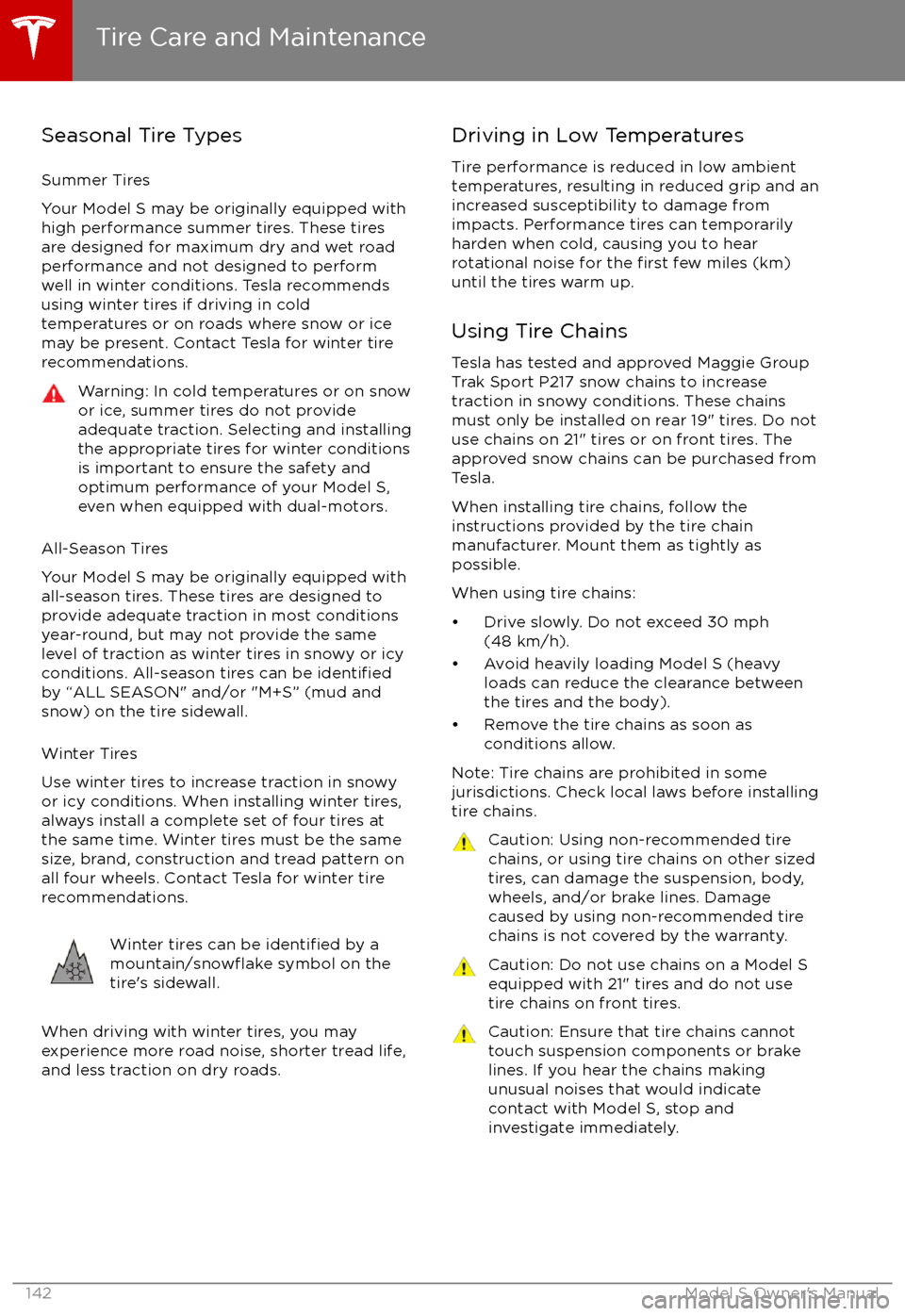
Winter tires can be identified by amountain/snowflake symbol on the
tire
Page 144 of 186

TPMS malfunctions can occur for a variety of
reasons, including installing replacement or
alternate tires or wheels that prevent the
TPMS from functioning properly. Always check
the TPMS malfunction indicator light after replacing one or more tires or wheels on yourvehicle to ensure that the replacement tires or
wheels allow the TPMS to continue to function
properly.
Note: If a tire has been replaced or repaired
using a
different tire sealant than the one
available from Tesla, and a low tire pressure is
detected, it is possible that the tire sensor has
been damaged. Contact Tesla to have the fault repaired as soon as possible.
Tire Care and Maintenance
144Model S Owner
Page 146 of 186
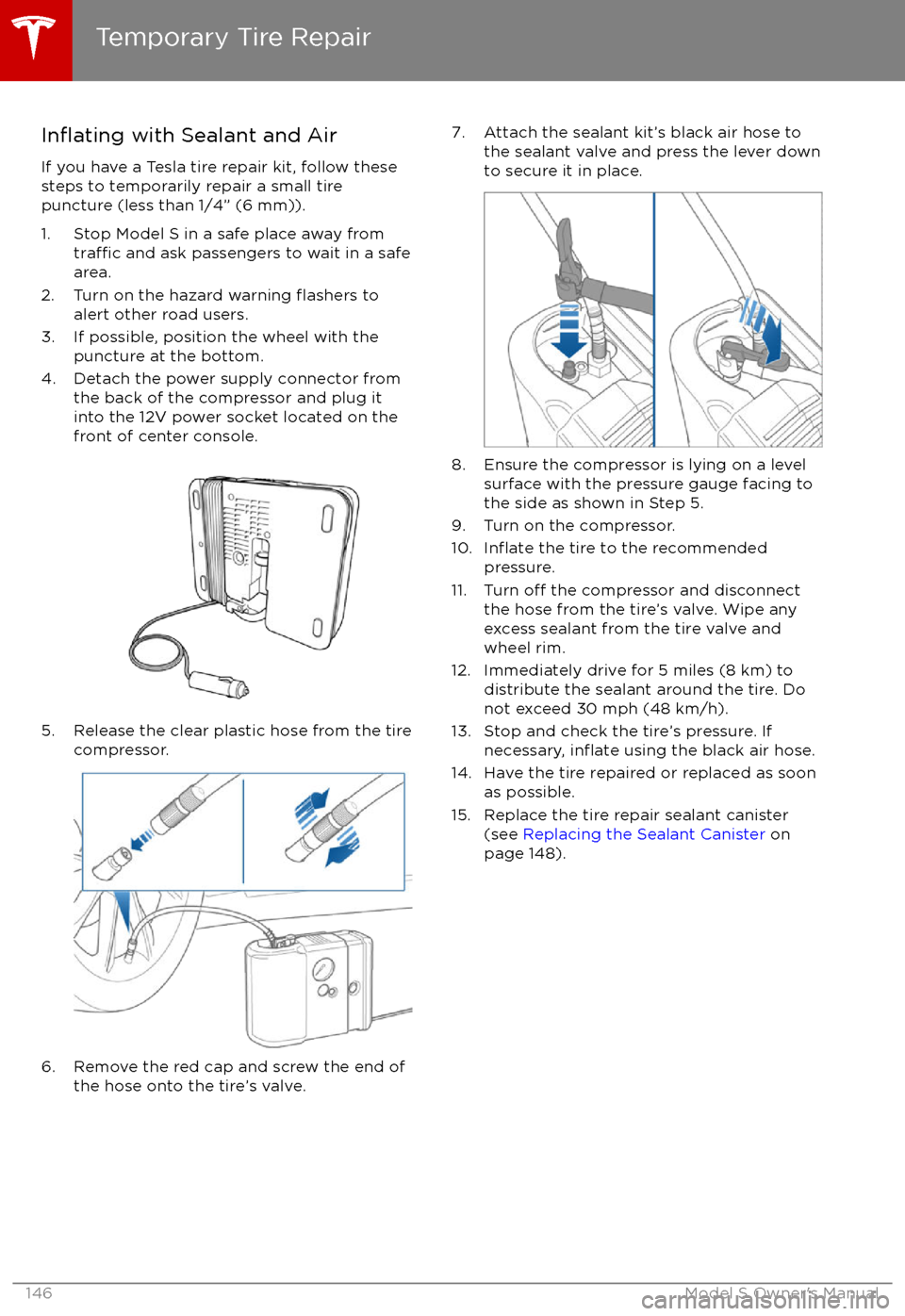
Inflating with Sealant and Air
If you have a Tesla tire repair kit, follow these
steps to temporarily repair a small tire
puncture (less than 1/4” (6 mm)).
1. Stop Model S in a safe place away from
traffic and ask passengers to wait in a safe
area.
2. Turn on the hazard warning
flashers to
alert other road users.
3. If possible, position the wheel with the puncture at the bottom.
4. Detach the power supply connector from the back of the compressor and plug it
into the 12V power socket located on the
front of center console.
5. Release the clear plastic hose from the tire
compressor.
6. Remove the red cap and screw the end of the hose onto the tire
Page 149 of 186

Cleaning the ExteriorTo prevent damage to the paint, immediately
remove corrosive substances (bird droppings, tree resin, dead insects, tar spots, road salt,
industrial fallout, etc). Do not wait until
Model S is due for a complete wash. If
necessary, use denatured alcohol to remove
tar spots and stubborn grease stains, then
immediately wash the area with water and a
mild, non-detergent soap to remove the
alcohol.
Follow these steps when washing the exterior
of Model S:
1. Rinse Thoroughly Before washing,
flush grime and grit from
the bodywork using a hose. Flush away
accumulations of mud in areas where
debris easily collects (such as wheel
arches and panel seams). If salt has been used on the highways (such as during
winter months), thoroughly rinse all traces of road salt from the underside of thevehicle.
2. Hand Wash
Hand wash Model S using a clean soft
cloth and cold or lukewarm water
containing a mild, good quality car
shampoo.
3. Rinse with Clean Water
After washing, rinse with clean water to
prevent soap from drying on the surfaces.
4. Dry Thoroughly and Clean Exterior Glass
After washing and rinsing, dry thoroughly
with a chamois.
Clean windows and mirrors using an automotive glass cleaner. Do not scrape,
or use any abrasive cleaning
fluid on glass
or mirrored surfaces.
Cautions for Exterior CleaningCaution: Do not use windshield treatmentfluids. Doing so can interfere with wiper
friction and cause a chattering sound.Caution: Do not use hot water and
detergents.Caution: In hot weather, do not wash in direct sunlight.Caution: If using a pressure washer,
maintain a distance of at least 12" (30 cm)
between the nozzle and the surface of
Model S. Keep the nozzle moving and do
not concentrate the water jet on any one
area.Caution: Do not aim water hoses directly
at window, door or hood seals, or through
wheel apertures onto brake components.Caution: Avoid using tight-napped or
rough cloths, such as washing mitts.Caution: If washing in an automatic car
wash, use Touchless car washes only. These car washes have no parts (brushes,
etc.) that touch the surfaces of Model S.
Using any other type of car wash could
cause damage that is not covered by the
warranty.Caution: Do not use chemical based
wheel cleaners. These can damage the
finish on the wheels.
Caution: Avoid using a high pressure
power washer on the rear view camera or
parking sensors (if equipped) and do not
clean a sensor or camera lens with a
sharp or abrasive object that can scratch
or damage its surface.
Cleaning
Maintenance149
Page 162 of 186
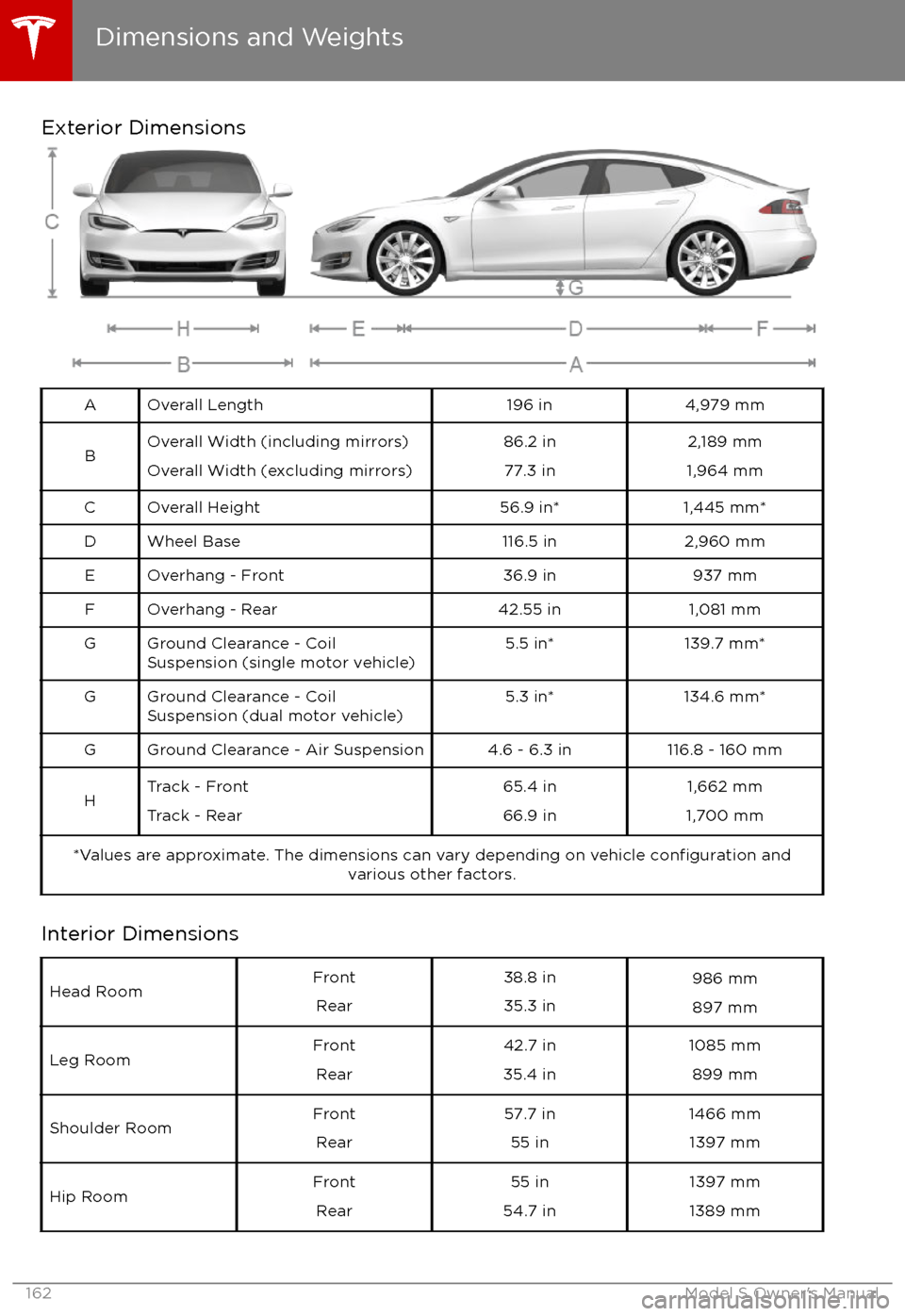
Exterior DimensionsAOverall Length196 in4,979 mmBOverall Width (including mirrors)Overall Width (excluding mirrors)86.2 in 77.3 in2,189 mm
1,964 mmCOverall Height56.9 in*1,445 mm*DWheel Base116.5 in2,960 mmEOverhang - Front36.9 in937 mmFOverhang - Rear42.55 in1,081 mmGGround Clearance - Coil
Suspension (single motor vehicle)5.5 in*139.7 mm*GGround Clearance - Coil
Suspension (dual motor vehicle)5.3 in*134.6 mm*GGround Clearance - Air Suspension4.6 - 6.3 in116.8 - 160 mmHTrack - Front
Track - Rear65.4 in
66.9 in1,662 mm
1,700 mm*Values are approximate. The dimensions can vary depending on vehicle configuration and
various other factors.
Interior Dimensions
Head RoomFront
Rear38.8 in35.3 in986 mm 897 mmLeg RoomFront Rear42.7 in
35.4 in1085 mm 899 mmShoulder RoomFront Rear57.7 in 55 in1466 mm1397 mmHip RoomFront Rear55 in
54.7 in1397 mm
1389 mm
Dimensions and Weights
162Model S Owner
Page 163 of 186

Cargo VolumeTotal cargo volume (rear seats not
folded)28.4 cu ft804.2 LRear cargo volume26.3 cu ft744.7 LRear cargo volume (with seats
folded down)58.1 cu ft1645.2 LFront cargo volume2.1 cu ft59.5 L
Weights
Curb Weight* - 60/70/754469 lbs2027 kgCurb Weight* - 60D/70D/75D4647 lbs2108 kgCurb Weight* - 90D4736 lbs2148 kgCurb Weight* - P90D4841 lbs2196 kgCurb Weight* - P100D4941 lbs2241 kgGVWR** - 60/70/755710 lbs2590 kgGVWR** - 60D/70D/75D5732 lbs2600 kgGVWR** - 90D5820 lbs2640 kgGVWR** - P90D5886 lbs2670 kgGVWR** - P100D5997 lbs2720 kgGross Axle Weight Rating- Front
(non-Performance vehicle)2813 lbs1276 kgGross Axle Weight Rating- Front
(P85D/P90D)2756 lbs1250 kgGross Axle Weight Rating- Front
(P100D)2866 lbs1300 kgGross Axle Weight Rating - Rear: 19"
wheels3307 lbs1500 kgGross Axle Weight Rating - Rear: 21"
wheels3131 lbs1420 kgTrailer TowingNot permissible*Curb Weight = weight of the vehicle with correct fluid levels, no occupants and no cargo
**GVWR = Gross Vehicle Weight Rating
Dimensions and Weights
Specifications163
Page 165 of 186

Brakes
Type
4-wheel anti-lock braking system (ABS)
with Electronic Brake Force Distribution,
Integrated Advanced Stability Control and
Electronic Accelerator pedal actuated
regenerative braking systemCalipersFour piston fixedRotor Diameters (ventilated)Front: 13.98”/355 mm
Rear: 14.37”/365 mmFront Rotor thicknessNew: 1.26”/32 mm
Service limit: 1.18”/30 mmRear Rotor thicknessNew: 1.10”/28 mm
Service limit: 1.02”/26 mmFront Brake Pad Thickness (excluding back plate)New: 0.354”/9.0 mm
Service limit: 0.078”/2 mmRear Brake Pad Thickness (excluding back plate)New: 0.315”/8.0 mm
Service limit: 0.078”/2 mmElectronic Parking Brake (EPB) Pad Thickness
(excluding back plate). Electronic calipers self-
adjust for pad wear.New: 0.216”/5.5 mm
Service limit: 0.039”/1 mmParking brakeElectrically actuated parking brake
calipers
Suspension
FrontIndependent, double wishbone, air spring
or coil spring/telescopic damper, sway barRearIndependent, multi-link, air spring or coil
spring/telescopic damper, sway bar (air
suspension vehicles only)
Battery - 12V
Rating33 amp-hr or higherVoltage and Polarity12V negative (-) ground
Subsystems
Specifications165
Page 167 of 186

Wheel SpecificationsWheel TypeLocationSizeOffset
19"
Front8.0J x 191.575"
40 mmRear8.0J x 191.575"
40 mm21" - Silver (standard)Front8.5J x 211.575"
40 mm21" - Grey (standard)Rear8.5J x 211.575"
40 mm21" - Silver and Grey (optional) Performance
Plus vehiclesRear9.0J x 211.575"
40 mmRoad Wheel Nut Torque129 lb. ft (175 Nm)Note: For instructions on how to jack/lift Model S, see Jacking and Lifting on page 157.
Tire Specifications
Tire TypeLocationSize19" wheelsAllP245/45R1921" wheelsFront
RearP245/35R21
P265/35R21**On a P85D and P90D Model S, the width of the rear tires may vary depending on date of
manufacture. Some vehicles may be equipped with P245/35R21 tires on both front and rear.Tire pressures vary depending on the type of tires fitted. Refer to the tire pressures printed on
the Tire and Loading Information label. This label is located on the center door pillar and is
visible when the driver
Page 168 of 186
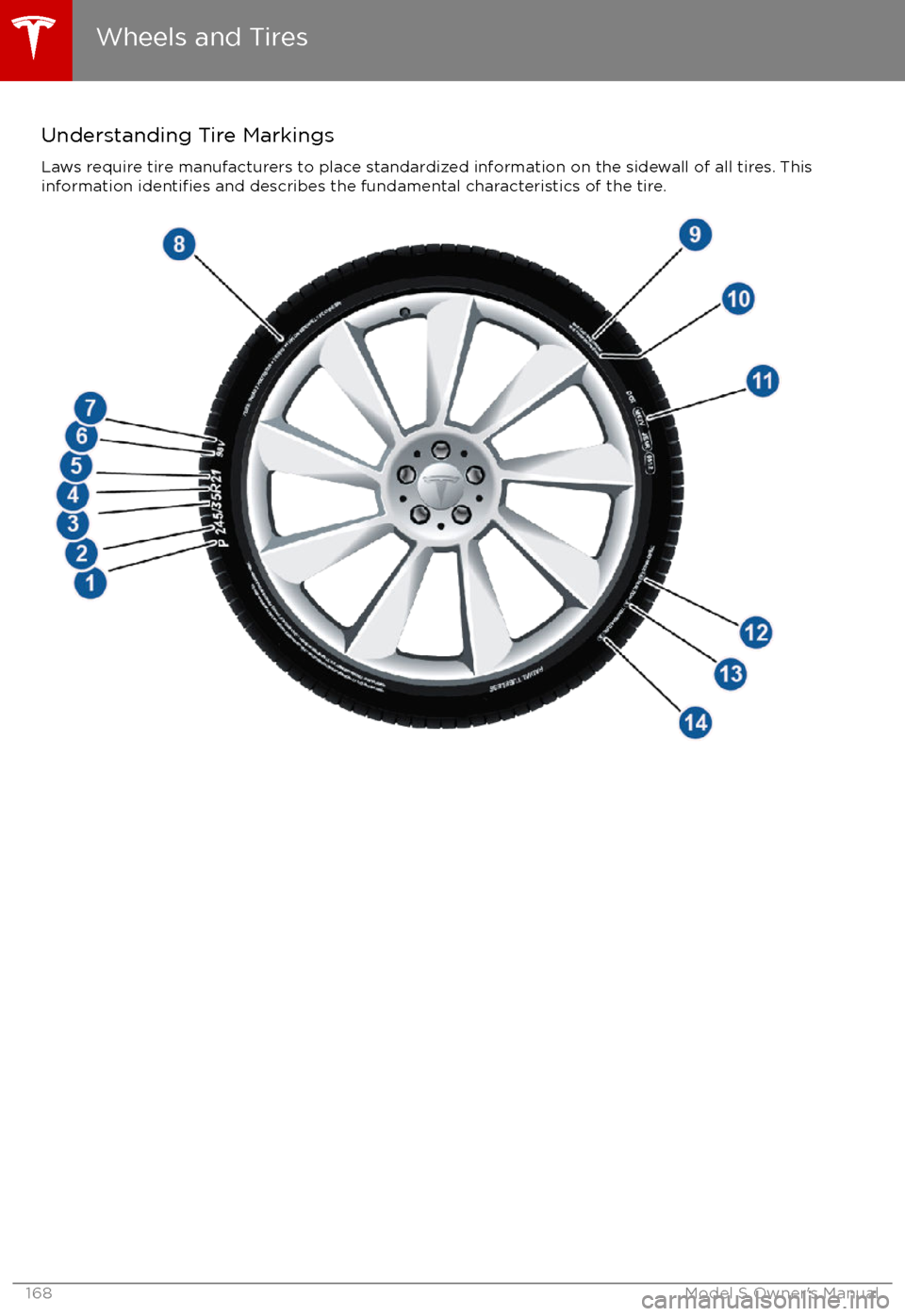
Understanding Tire MarkingsLaws require tire manufacturers to place standardized information on the sidewall of all tires. This
information
identifies and describes the fundamental characteristics of the tire.Wheels and Tires
168Model S Owner